
Dental Implants vs Bridges: Which Is Better?
Missing teeth can affect far more than your appearance. Tooth loss may impact your ability to chew properly, speak clearly, and maintain good oral health. Fortunately, modern dentistry offers effective solutions to restore missing teeth — with dental implants and dental bridges being two of the most common options.
But which is better: dental implants or bridges?
The answer depends on several factors, including your oral health, budget, lifestyle, and long-term dental goals. In this guide, we’ll compare dental implants vs bridges in detail to help you understand the advantages, disadvantages, and which option may be most suitable for your smile.
What Are Dental Implants?
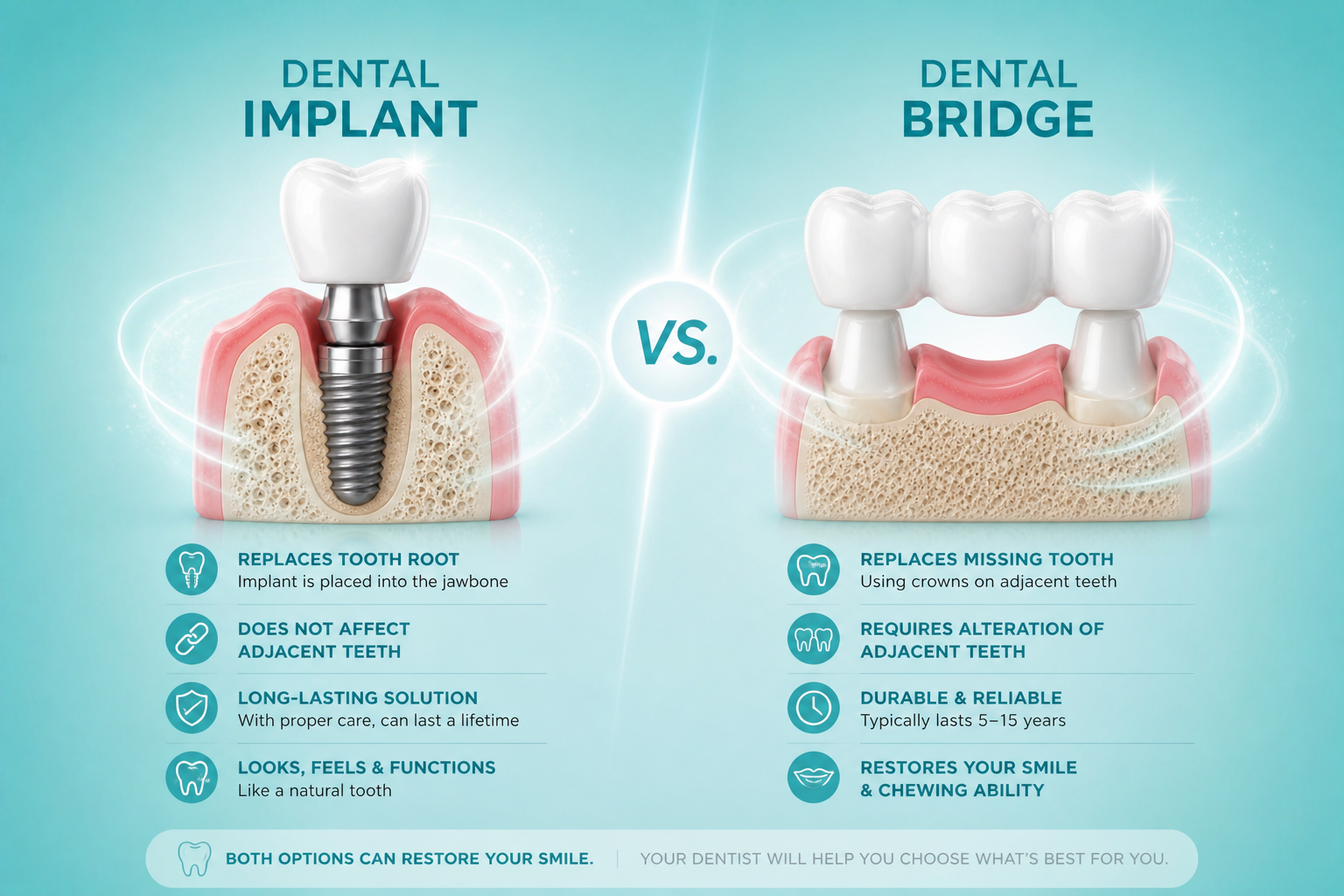
Dental implants are artificial tooth roots, usually made from titanium, that are surgically placed into the jawbone. Once the implant integrates with the bone, a dental crown is attached to restore the appearance and function of the missing tooth.
Dental implants are designed to function similarly to natural teeth and are considered one of the most durable tooth replacement options available today.
What Are Dental Bridges?
A dental bridge is a restoration used to replace one or more missing teeth by “bridging” the gap between healthy teeth.
Traditional bridges are supported by the natural teeth on either side of the missing tooth. These supporting teeth are typically reshaped to hold dental crowns that anchor the bridge in place.
Bridges can restore chewing ability and appearance without requiring surgery.
Dental Implants vs Bridges: Key Differences
1. Longevity and Durability
Dental Implants
Dental implants are known for their long-term durability. With proper care and good oral hygiene, implants can last for many years — often decades.
Because the implant integrates with the jawbone, it provides strong support and stability similar to a natural tooth root.
Dental Bridges
Dental bridges generally have a shorter lifespan compared to implants. While bridges can last many years with proper maintenance, they may eventually require replacement due to wear or damage to supporting teeth.
Which Is Better?
For long-term durability, dental implants are often considered the superior option.
2. Impact on Surrounding Teeth
Dental Implants
One major advantage of implants is that they do not rely on adjacent teeth for support. This means healthy neighbouring teeth remain untouched.
Additionally, implants help stimulate the jawbone, which may reduce bone loss after tooth extraction.
Dental Bridges
Traditional bridges usually require the adjacent healthy teeth to be filed down to support the bridge structure.
Over time, the supporting teeth may experience additional stress.
Which Is Better?
Dental implants are generally more conservative because they preserve surrounding natural teeth.
3. Jawbone Health
Dental Implants
When a tooth is lost, the jawbone in that area may begin to shrink due to lack of stimulation. Dental implants help maintain bone density by acting like natural tooth roots.
Dental Bridges
Bridges replace the visible tooth structure but do not stimulate the jawbone beneath the missing tooth.
Which Is Better?
Dental implants offer significant advantages for preserving jawbone health.
4. Treatment Time
Dental Implants
Implant treatment usually takes longer because healing and integration with the jawbone can require several months.
Some patients may also need additional procedures such as bone grafting.
Dental Bridges
Dental bridges can often be completed more quickly, sometimes within a few appointments.
Which Is Better?
If faster treatment is important, bridges may be the more convenient option.
5. Cost Considerations
Dental Implants
Dental implants often involve a higher upfront cost due to surgery, materials, and specialist treatment.
However, their long lifespan may provide better long-term value for some patients.
Dental Bridges
Bridges are usually less expensive initially compared to implants.
However, replacement or maintenance costs over time should also be considered.
Which Is Better?
Bridges may be more affordable in the short term, while implants may offer better long-term investment value.
6. Maintenance and Oral Hygiene
Dental Implants
Implants can typically be cleaned similarly to natural teeth with brushing and flossing.
Dental Bridges
Bridges may require additional cleaning tools to clean underneath the bridge properly.
Poor cleaning can increase the risk of gum disease or decay around supporting teeth.
Who May Be a Good Candidate for Dental Implants?
You may be suitable for dental implants if you:
have healthy gums
have sufficient jawbone density
do not smoke heavily
maintain good oral hygiene
are looking for a long-term tooth replacement solution
Who May Be a Better Candidate for Bridges?
Bridges may be more suitable if you:
want a faster treatment option
prefer to avoid surgery
have insufficient bone for implants
are looking for a lower upfront cost solution
Are Dental Implants Always Better Than Bridges?
Not necessarily.
While dental implants offer many long-term benefits, they are not ideal for every patient. Factors such as medical history, bone health, treatment goals, and budget all play an important role in determining the best option.
A professional dental assessment is essential before choosing the right treatment.
Questions to Ask Your Dentist
Before deciding between implants and bridges, ask your dentist:
Which option is best for my oral health condition?
How long will treatment take?
What are the long-term maintenance requirements?
What are the total treatment costs?
Am I suitable for implant surgery?
Final Thoughts
Both dental implants and dental bridges can effectively restore missing teeth and improve oral function. Dental implants are often preferred for their durability, bone preservation, and natural feel, while bridges may offer a faster and more affordable solution for some patients.
The best choice depends on your individual dental needs, oral health condition, and long-term goals. Consulting an experienced dental professional is the best way to determine which treatment is right for you.
Book Your Consultation
At Euro Dental Care, we provide personalised tooth replacement solutions designed to restore both function and confidence. Whether you are considering dental implants or dental bridges, our experienced dental team will guide you through every step of the process and recommend the most suitable treatment for your oral health needs.
We are committed to delivering high-quality, patient-focused dental care using modern techniques and advanced restorative solutions.
Book a consultation with Euro Dental Care today and discover the best option to restore your smile with confidence.